Tuesday, May 27, 2025

Recent Watches

 Long time no post! 

I consider myself a very avid movie watcher. I definitely watched more movies over the Covid-19 pandemic than I do now (working full time will do that), but I still try to make time to do a double feature once in a while! 

I actually saw the 2024 Nosferatu in theaters twice; once after Christmas with my friends, and again a few months later with my fiancĂ© and his best friend. I absolutely loved that movie, it's everything I want in a classic horror remake! I think the contrast in Orlok's characterization when compared to Herzog's 1970's version, or even the original, is really fascinating. Herzog's Orlok feels simpering and pathetic to me, someone who is desperate for love and attention. Eggers' Orlok combines sexuality with disgust to create a character that is both commanding and repulsive, and I think that play on the titular character makes his whole take on the story feel fresh and interesting. 

That's the only movie I've seen in theaters this year (so far), but I've watched a lot of movies at home! They haven't all been winners, but I wanted to talk about some of my favorites. 

Dellamorte Dellamore (1994) 

I can't stop thinking about this movie, and I don't know that I ever will. I watched it in Italian maybe a decade ago, but rewatched the dubbed version again with my fiancĂ© last night... and the whole story finally clicked for me. 
SPOILERS AHEAD: my theory is that Franco and Francesco are the same person (I know, duh). Franco Dellamore works as a civil engineer for a corrupt mayor, feels trapped in his relationship with his wife, and feels like he's nothing but a walking wallet for his college-aged daughter. This is exemplified by the character She and the times she appears throughout the film. I think he had an affair with his secretary (She in the real world), felt overwhelmed with guilt and killed his daughter and wife, and then attempted to kill himself... but he missed (the same way he misses She's brains the first time he shoots her, and the reason it's emphasized that you have to hit the head throughout the movie) and put himself in the coma we see him in near the end of the film. The entirety of the movie is Franco Dellamore's guilty psychosexual fever dream, where he creates a new sexy persona (Francesco Dellamorte) to compensate for his feelings of emasculation and the notion that his sexuality (having an affair with She and committing the murders of his wife and daughter) caused his life to fall apart. He is simultaneously running from his guilt, and begging someone in his dream to hold him accountable for his crimes. 

I think that if Francesco Dellamorte is Franco's Superego, Gnaghi is his Id. Gnaghi is the anchor that tries to keep his brain alive (keep the dead leaves from blowing away) and represents his base instincts (eating, sleeping, joy, the grossness of human life) while Francesco runs around murdering people, reading the phone book, having sex with the trauma ghost of his affair partner and evading the police. Francesco speaks to Franco on the phone and justifies his crimes, saying that he's finally free, while Gnaghi tries to signal that what he's doing is wrong. 

Dellamorte Dellamore (I refuse to call it Cemetery Man, that title is in no way indicative of what this movie actually is) has definitely earned a spot among my favorite films, and I'm so happy I decided to give it another watch! 

The Vourdalak (2023) 

Took me long enough to watch this one! This is another movie that became an immediate 10/10 for me. Everything about it is visually stunning, and it was the most elegant take on gender and sexuality I've seen in recent history. The vourdalak sucking on their shrouds is also one of the most unsettling things I've EVER seen in a horror movie; it sounds innocuous, but the uncanny valley factor of the puppet combined with the sound effects of the sucking is genuinely horrifying. It's the most perfect version of the "came back wrong" trope, combined with insightful commentary on hypermasculinity, repressed sexuality and familial love. 

The Dead Don't Die (2019) 

I guess when you're Jim Jarmusch, you can kind of start phoning it in and do whatever you want. This is not to say I didn't like the movie; I actually kind of loved it. Jim Jarmusch assembled all his favorite actors and basically played with them like action figures for an hour or two, and it was riveting. But it's such a completely absurd movie that any attempt to analyze it makes you sound like a giant pretentious ass, so I'm not even going to try. 


Batman (1989) and Batman Returns (1992)

Personally, I think we should hand total creative control of Batman IP over to Tim Burton, because nobody has ever done it better than him. I grew up very into DC Comics, but I wasn't able to fall in love with Batman as an adult until I saw these. Burton somehow captured everything that was great in Adam West's Batman, but contrasted it with Brutalist and Art Deco architecture and the signature Burton macabre vibe to create a wholly new product that feels truer to the comics than any other adaptation. The costuming, set design, makeup and performances are all so incredible, but the stories are really what got me. I really appreciate that the conflicts are so small-scale: the whole world isn't at stake, it's just one horrible little city that might not be worth saving anyway. That to me is the core of Batman, one rich kid with a hero complex fighting a Sisyphean uphill battle to save a place that, while awful, is his home. 

That's all for now! If you have any theories about Dellamorte Dellamore, PLEASE comment them. I feel like I'm still piecing the whole thing together! 

Friday, March 7, 2025

Sex, Robots, and Fear of Adulthood: Exploring Lychee Light Club

"Do you understand why the Hikari Club boys wear gakuran and insert German into everyday conversations? Do you understand why it isn't simply fashion, or cosplay? Do you know what it means to put on a play in the 80s, with a group of people that go out of their way to wear gakuran?" - Tsunekawa Hiroyuki, December 17, 2015.


I first heard the title Lychee Light Club thrown around about a decade ago, usually in the same breath as No Longer Human by Osamu Dazai. While Dazai has gotten mainstream acclaim for his work, Furuya's manga adaptation of Lychee Light Club still remains so underground that I had to special order it online from a Canadian publisher who printed too close to the bottom margin of the page. Naturally, as I do with all obscure works of media, I've latched on to the Light Club in all its forms and done some online digging... and I've found so much to talk about! Strap in and turn your screen brightness down to avoid eye strain, because there are a LOT of words coming at you.

What Is Lychee Light Club?

In its most popular form, Lychee Light Club is a manga by Usamaru Furuya, about a group of middle school boys led by the charismatic, iron-fisted (and, in the original work, iron-codpieced) Zera. Zera and his friends/lovers/disciples meet in an abandoned warehouse after school to play chess, scheme, have illicit underage gay sex, and build a robot powered by lychee fruits that will help them kidnap girls their age and build an ideal world free from the drudgery of adult life. The manga is beautifully drawn and written, with a lot of turns of phrase that stuck with me despite their limited character count. However, the manga had an oft-forgotten predecessor: a production unlike any other.


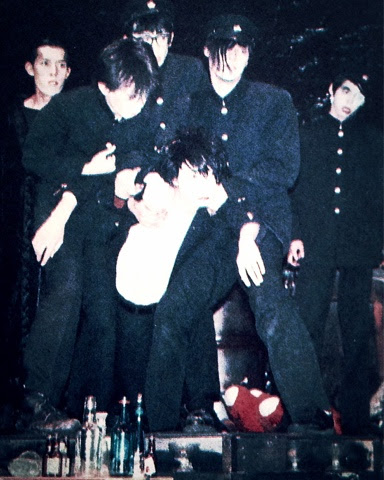
The original Lychee Light Club was a stage play, put on in 1985 by the short-lived theater troupe Tokyo Grand Guignol. There is no video recording of the show, and there is one audio recording, which is in the possession of Tsunekawa Hiroyuki, the actor that played Zera. Denpa Archives translated a blog post from a defunct Japanese blog with a summary of the play, which is essentially the only account of it that still exists. Notably, the production described has a few key differences: in the original play, the boys did not engage in homoerotic trysts as a way to stave off adulthood, but rejected any sexuality at all and instead wore iron chastity belts. Jaibo, who you could argue is the antagonist in both works, is motivated not by love but by pure hatred, a cold detachment opposite his passionate declaration of love for Zera in the manga.

What Was Tokyo Grand Guignol?

To talk about Tokyo Grand Guignol, we need to give a brief run-down on the original Grand Guignol. The Theatre du Grand-Guignol was a French production company that operated out of a converted chapel, and sat 293 people at maximum capacity. The intimate setting and Gothic architecture gave way to a new form of theater, featuring gory and shocking stories interspersed with slapstick comedies, and audiences so close to the stage that they might be hit with the errant drop of fake blood. The Grand Guignol ran shows until shortly after World War 2, and the location is now home to the International Visual Theater.

Some of the cast of the TGG show, courtesy of Denpa Archives

Tokyo Grand Guignol, then, is an homage to the violent, bloody and irreverent Grand Guignol of Paris, carrying on the tradition of Naturalist theater by dissolving the divides between actor and audience. Despite the mark left by this troupe on Tokyo's art scene, only four documented plays were ever put on in Tokyo Grand Guignol's history, of which Litchi Hikari Club was the third. The troupe was founded by experimental artist Norimizu Ameya (who would go on to play Jaibo in Litchi Hikari Club) in collaboration with horror manga author Suehiro Maruo (who famously authored and illustrated the pioneering ero-guro manga Shojo Tsubaki, aka The Girl from the Freakshow), who both prioritized a sort of punk-adjacent DIY ethos with a focus on audience interaction and immersion. Suehiro's manga Shojo Tsubaki was adapted for the screen by Hiroshi Harada, who staged guerilla screenings of the movie with a distinctly TGG feeling; mazes leading to rooms with actual circus sideshow performances, secretive ticket distribution, and fully immersive sound effects and settings, creating a truly unique experience that cannot be replicated via DVD distribution. TGG shows were allegedly much the same, with stripped-down sets, gaudy makeup, and lines being shouted over a booming soundtrack of Devo, Public Image Ltd, and the noises of torture and industrial machinery.

What Is The Meaning of Lychee Light Club?

The story I've outlined so far is surrealist, uncomfortable, and distinctly odd - and believe me, it is all of that and more. But at its core, Lychee Light Club is a story about the enduring nature of fascism, the radicalization of young men in our modern age, the growing gender divide between young men and women, and the microcosm of cruelty and paranoia that groups of teenagers can breed. There are a few key points I'd like to outline that I think give way to a deeper understanding of both iterations of the work:

1. Ero-guro in Japan


"Ero guro nansensu" (erotic gore nonsense) was popularized in Japan's Showa era, which was approximately around The Great Depression in America. This term referred to stories by authors like Edogawa Ranpo (a Romanized pen name meant to sound like Edgar Allan Poe) and art by Ukiyo-e painters that drew erotic scenes of crucifixions and beheadings. This genre was akin to the British penny dreadful, and was highly censored and suppressed during WW2, but emerged as simply "eroguro" and was popularized again after the war. The genre now takes on highly erotic or pornographic elements, and an air of decadence and excess, contrasting beauty and sexuality with disgust and decay, rotting flesh, bodily fluids and dismemberment. A few bands under the visual kei genre umbrella, such as gulugulu and THE GALLO, have taken on the term "eroguro" to describe their lyrics and aesthetics.

In Lychee Light Club, the erotic elements are inherently grotesque, horrific, and uncomfortable, much like the use of body horror from directors like David Cronenberg. 13 and 14-year old boys committing sexual assault with metal pipes, stripping and murdering a teacher, and engaging in manipulation via sex is not meant to be sexually arousing to the reader, but to link sex to violence. This is further driven home by the boy's fear of adulthood and use of chastity belts in the play; sex is a gateway to adulthood, and is therefore something shameful and evil, a tool to inflict violence as (in their minds) adults have inflicted violence upon them, their town, and their futures.

2. The gakuran uniform


I mean, even a surface level glance at the gakuran could tell you a lot about why this was chosen for the members of our Light Club. To be perfectly frank... it looks like a Nazi SS uniform, and that's because they share the same source material: Prussian military uniforms.


The gakuran in its earliest form, circa 1870, consists of a flat military cap, a standing-collar shirt and jacket, and matching pants. It was designed during a time when Japan was becoming increasingly militarized, and was meant to encourage strong militaristic values in the young men of the era. But, as Japan became Westernized, the gakuran in its fullest form (namely, with the hat) fell out of fashion, often being replaced with a blazer and tie for high schoolers.

So then, as Tsunekawa asked in his quote at the beginning of this post: do you understand why the boys of the Light Club wear gakuran?

The gakuran with the cap was worn by the performers of Lychee Light Club in the 1980's, a time when this iteration of the uniform would have been seen as an outdated relic of a more militaristic time. The cap and white gloves worn by Zera, who in the manga is told that he has "a black star over him that not even Adolf Hitler had," paints a clear parallel to an unstable dictator. Furthermore, boys about to go into high school, yet clinging to their gakuran in its most old-fashioned form, signifies the boys' refusal to enter the world of adulthood and the decrepit, outdated nature of the manufacturing town they live in. When combined with the garish makeup worn on stage, the effect is one of a ghoulish arrested development, a lost child and an undead fascist all at once.

3. The robot and Kanon


The character Kanon, the young girl kidnapped by the robot Litchi, went by the name Marin in the stage play. I'll be referring to her as "Kanon" when talking about both iterations for the sake of clarity, but I wanted to call out her original name here!


First off, we'll talk about the nominal Lychee/Litchi, the robot built out of scraps and human body parts that serves as the great purpose of the Hikari Club boys. Litchi is controlled via a calculator, and is given consciousness via the command "I am human." Zera states that there is fundamentally no difference between a robot and a human, because all human beings are is logical collections of moves, like a chess set.

I know, what a pretentious little dickhead.

Litchi, the robot, defies this, proving himself to be more human than the actual people who built him. With Kanon, the kidnapped girl, he learns to love, remember, and eventually defy the cruelty of his makers.

Kanon is the character that brings down the house of cards built by Zera, and is the Madonna to the whore of... basically every other woman in the play and manga. Kanon, originally just a representation of the ideal girl, sits upon a rusted-out throne for most of the story. She pretends to sleep all day, but interacts with the robot Litchi at night, singing with him and telling him stories. Kanon and Litchi fall in some semblance of love, and her love undoes his programming and makes him a human being. We don't get much background on Kanon, but she seems cooly detached for the entirety of her stay in the Light Club hideout, with Litchi being the only person or thing to arouse emotion in her. She, in turn, is the only female character to arouse anything other than hatred in the boys; they sexually assaulted one of the group's younger sisters with a metal pole in the manga, and abuse and murder their teacher in both versions. Where other girls and women are treated with disgust, the boys treat Kanon with a mixture of arousal, awe, and disbelief, making Litchi a target for their ire and hatred when Kanon falls for him.

The manga, though, gives Litchi and Kanon a happier ending than the stage play. In the manga, Kanon and Litchi get to speak one last time, and Kanon escapes as the warehouse becomes a watery grave for the members of the Light Club.

The play, however, allegedly ended as follows:

When the lights return, Litchi sits in the center of the stage, lifeless. Marin (Kanon) is lying in his lap with a strange hat on her head. Zera stands behind them, seeming to live on forever.

Zera: "I will stand here and watch. I will stand here and watch as our machine named Litchi slowly rusts away. I will watch this so-called Marin rot away until she is nothing but bones. Gentlemen... Bohren! Beginen!"

Zera takes out his whistles and tweets. The sheets strung up behind him fall. A number of stepladders are revealed, with the Hikari Club members sitting on them and shining lights on each other's bloody faces. The stage slowly goes dark amidst the strong sound of caning.

4. The lychee fruits


Zera is obsessed with a few things: Emperor Elagabalus of Rome, chess, and Yang Guifei, a princess and imperial concubine who favored lychee fruit. Yang Guifei is one of two women mentioned favorably throughout the story, three if you count the queen chess piece. The robot Litchi, despite being referred to as male, is also referred to as the Queen piece of the Light Club (with Zera being the Black King), and runs solely on lychee fruit. The monster as a cultural body being a reflection of taboo cultural desires, showcases the boys' hopes and dreams; their desire for women and hatred of them in tandem, their sexual desire and hatred for each other, and their search for meaning. The lychee fruit represents femininity, but also eternity; it represents that the thing that destroys them is simultaneously the thing that saved them, that granted their wish for a life free from adulthood.

The lychee, grown in a local dump in the manga, also represents the loss of their shared dream, and the loss of hope in their bleak industrial town. Niko and Tamiya, manipulated by Jaibo, are framed for burning down the lychee field that Zera carefully cultivated. This is a turning point in the story, where Zera feels his control begin to slip, and realizes his shoddily constructed ideal is slipping through his fingers. In this way, Jaibo cements his place as Zera's trusted advisor, alienating him further within their already alienated circle, and sets the stage for the final stand of the Light Club.

5. The use of German


The Hikari Club speaks in broken German phrases, both in the play and the manga. This is intentionally alienating for the reader and viewer of the play, so much so that the translator of my copy of the manga did not translate these phrases to retain their effect. Aside from the obvious reference to Nazism, speaking German serves to both alienate the boys from their other classmates, and create a shared language within their group. The speaking of German designates an "in" crowd and an "out" crowd, creating a shared dialect within their microcosm that further serves to isolate them.

Whose Light Club Is It, Anyway?


The following is a statement made by Tsunekawa Hiroyuki on December 17, 2015.

"Usamaru-kun reached out to me. Apparently, Ameya Norimizu strongly pushed for Hikari Club to be published as an original work, rather than a derivitive one. That sounds like something he'd do. Neither the publisher nor Usamaru-kun had the intention of marketing Hikari Club as an original work."

Both in the story and in real life, there's a lot of contention surrounding the intellectual property of Lychee Light Club. Though Furuya allegedly tried to market Lychee Light Club as a derivative work, giving credit to TGG, Ameya, leader of the troupe and the actor that played Jaibo (ironically, the betrayer of the Light Club) pushed for it to be sold as an original work. The real-life Zera, as you can see, was not happy about this, nor about their work being introduced to the mainstream via a poorly received movie and anime adaptation. "The movie, Lychee ☆ Hikari Club is an adaptation of Furuya Usamaru's Our Hikari Club, right? That I understand. Bokura(Our Hikari Club) is Usamaru's world. Litchi Hikari Club doesn't ring a bell anymore. The original cast and our history of theater has been removed from the Hikari Club name. First it was Death Note, then it was Litchi. More and more underground works are being diluted and adapted into silly movies that are popular for a while, then forgotten when the audience gets bored. I hate that kind of mass media."

In the manga, there are similar contentions surrounding who the "leader" of the Light Club really is. The Club worships Zera like a dictator, taking his word as law and often chanting his name like a psalm. At least two of the boys are in love with Zera, and he clearly relishes in the power. However, as we read, we learn the Light Club originally belonged to Tamiya, Kaneda, and Dafu, and was simply a place for these friends to spend time together. Zera was brought in early on, and with the help of Niko and Jaibo (who kind of just came out of nowhere), he succeeded in overtaking the club through sheer force of charisma, making the others obey through peer pressure and torture.

The question remains: who was the real leader? Who owns art once it becomes mainstream? Is your art still yours, when the meaning becomes diluted? Can anything shared ever be owned?

I loved Lychee Light Club, loved it enough to type out a short essay on it using an iPhone keyboard (please excuse the formatting issues). Part of me hopes it gets more widespread popularity... but part of me really hopes it doesn't.


Sources

I'm not going to type an actual bibliography, because this is my blog and not an essay. However, I do want to call out and specially thank the websites I used as sources outside of my copy of the manga and Mel Gordon's Theater of Fear and Horror.

For information on the production Lychee Light Club, including photos and a soundtrack, visit: https://denpaarchive.neocities.org/litchi

For information on Tokyo Grand Guignol, including a script, visit: https://mutantfishproductions.com/misc.htm

For information on gakuran uniforms and their tie to Japanese militarism, visit: https://www.journal.media-culture.org.au/index.php/mcjournal/article/view/1041

Monday, February 10, 2025

Tag: Get To Know My Blog

 I was tagged by my dear friend Mika (cashmerecrypt) in this post, and I am DELIGHTED that these tag posts are coming back!!! I was around for the DeviantArt and blog memes (remember when "meme" was used to mean written tag posts almost exclusively?), but was too young to actually participate. This is just another part of our small friend group's quest to bring back early 2000's visual kei internet, and I for one love it so much. 

Why did you start blogging in the first place?

I started blogging so that I had a place to put all my thoughts! I am very "academic brained" after four years of English major media analysis, and I was lamenting that I no longer had a reason to write essays. Having a blog lets me do media analysis in a more casual way, and share my hobbies and photos! I don't love social media, but I do love having my own little space on the internet. 

What platform are you using to manage your blog and why did you choose it?

I use Blogger! I wanted to try Neocities, but after learning some rudimentary HTML and giving it my best shot, I realized I probably should just switch to a pre-made platform. I would still love to create a Neocities site in the future, though! 

Have you blogged on other platforms before?

I had a Tumblr, though I'm unsure if that counts? I used Wordpress for a college class where my professor had us writing book reviews in a blog-style format, so needless to say, that kind of put me off of Wordpress lol. I'm not a tech person, so Blogger is fine for me! It does exactly what it needs to do. 

How do you write your posts? For example, in a local editing tool, or in a panel/dashboard that’s part of your blog?

I use the Blogger post thing, which is so incredibly annoying to use via phone. 

When do you feel most inspired to write?

There's zero rhyme or reason to it, sometimes I go a month without wanting to and then make three posts in as many days. 

Do you publish immediately after writing, or do you let it simmer a bit as a draft?

Again, zero rhyme or reason. It happens how it happens! My writing for work is so regimented, my blog is a place for me to do the exact opposite. 

What’s your favourite post on your blog?

Probably my media analyses, my first post ever was on Godchild/The Cain Saga and I had a lot of fun with it! I'd like to do some better and more in-depth ones in the future, I feel like the media posts I have up now aren't particularly insightful and sort of just a way to get my thoughts down. 

Any future plans for your blog? Maybe a redesign, a move to another platform, or adding a new feature?

MORE OUTFIT POSTS, FOR THE LOVE OF GOD. I constantly forget to take outfit photos! I'd also like to do better, more in-depth media analyses, but also more low-effort fun posts like inspiration photo dumps. 

I don't have anyone to tag, but PLEASE do this too and tag me in it! 

Thursday, December 19, 2024

Review: Shiki and the Horror of Small Towns

It ended, as all good stories and kept secrets do, with a fire.


  The 2010's anime Shiki proves that, no matter where you are in the world, small towns are (mostly) the same; despite being set in rural Japan, the village of Sotoba could be exchanged for any number of rural towns across America. There's a hospital, a local farming industry, gossiping old people, and not much else. 

Except for the vampires. Those are there, too. 

I just finished a rewatch of the series after trawling the internet for it (I originally watched it on Hulu, but it's been taken down from all streaming services), and I wanted to take another look at the morality and horror of Shiki. In a way, I would consider this series a better take on 'Salem's Lot by Stephen King; I think it does the "isolated village infested with vampires" thing in a more interesting way, by playing up the horror of humanity more so than the supernatural. I also think Shiki does a good job of not spoon feeding morality, and gives you reasons to sympathize with every character (human or otherwise).

Sotoba is a small farming village, and its main industry is growing the trees that become grave markers. When a new family moves in to the English-style manor above the town, villagers start dropping like flies from an epidemic nobody can identify (spoiler: it's vampires). But the most terrifying aspect of Shiki is not the fanged creatures that lurk in the darkness; the true horror comes from the maelstrom of tradition, insularity, superstition and guilt that haunts every small community.

In Shiki, the vampires very clearly represent a cultural Other to the citizens of Sotoba. The Kirishiki family wears flashy clothes, live in an ostentatious house, and ignore the traditions of the village. This introduces us to the fragile ideal of normality in Sotoba. Once their way of life is even slightly disrupted by something culturally abnormal, the villagers see a slippery slope and grab a sled. This story is very similar to my other favorite novel-turned-anime, Another by Yukito Ayatsuji. Both series operate on subverting the Japanese cultural ideal of the group being more powerful than the individual, showing how quickly following the will of the group can turn nasty, exclusionary, and even violent. 

Toshio, the village doctor, calls to mind a slightly more purposeful Light Yagami. Given the task of carrying on his family name and becoming a doctor, and constantly watched over by his domineering mother (even as a grown man), Toshio is under so much pressure that the discovery of the nominal shiki (literally "corpse demon") in Sotoba is all it takes to send him fully over the edge. Early in the series we see him in furious denial as his childhood friend, the junior monk/author Seishin who has befriended the vampire Sunako Kirishiki, warns him that death records are being tampered with. However, as soon as Toshio's estranged wife rises as a shiki, he wastes no time experimenting on (and eventually killing) her. Now fully convinced, Toshio fans the flames of hysteria in the village, killing Chizuru Kirishiki in front of the villagers to prove the existence of shiki and encouraging a mass slaughter that (surprise) gets completely out of hand. 

In my mind, if there really is a villain in this series, it's Toshio. A key aspect of the story is choice and intent; Seishin feels trapped in his role as a monk, Toshio feels trapped in his role as a doctor, the shiki are forced to drink blood, everyone is stuck in a small town with no economic hopes of getting out. One point emphasized over and over is that killing is only murder if there is intent behind it, something that Sunako Kirishiki agonizes over when reflecting on the human lives she has taken in order to live. 

This is all to say that, despite these obligations, everyone in the series has the ability to make their own choices. Almost every single choice Toshio makes is needlessly violent, cruel, and destructive, from experimenting on his undead wife, to her eventual murder, to masterminding the slaughter of innocent villagers. His intent was behind every single one is these actions, but he acts morally justified even as he and some survivors drive off into the night at the end of the series. 

On the topic of choice, we see vampires who abstain from drinking blood even as it slowly kills them, humans siding with the vampires, and both being called traitors to their respective causes. It's essentially an exaggerated version of the "us vs. them" politics we see in real-life small towns, where you're expected to keep to your own kind and shamed for breaking the mold. Toshio says the quiet part out loud and incites violence against the shiki, urging the townsfolk to drive them out. This culminates in one of the first shiki to be turned, a girl named Megumi, begging the townspeople to remember who she was and let her go so she can see the big city... as they bludgeon her and eventually crush her skull with a tractor. It's a harrowing moment that, if you were still siding with the townspeople, really makes you question your allegiance to the human race. 

The shiki's ultimate goal is to turn Sotoba into a town full of the undead, but not for nefarious purposes. Over and over, the original vampires of the Kirishiki family state that they just want a place where they can be normal. Chizuru talks about wanting to go out shopping and talk with friends, and the newly-turned shiki enjoy things like mundane office culture or idle chats in the street. Two undead teenagers congratulate an older woman on her husband "rising" to join her, saying how happy they are for the couple as they move to sink their teeth into a human's neck. Sunako Kirishiki recounts her life as a vampire, and cries over her desire to live and be a normal young girl as the townspeople ransack her home. 

Shiki turns monsters into humans, and makes its human characters into monsters. It turns a small town that is figuratively cut off from the world into one that is literally cut off and cannot be escaped. It explores the horror of boundaries, guilt, and isolation by using vampires as kindling to fan the simmering flames of resentment and doubt. It's a truly fantastic anime that has basically been scrubbed from the annals of 2010's anime history, remembered only by those who watched it and those who can dredge it up from the bowels of the internet.

 I'm not advocating for piracy, but I am saying that it's available on YouTube as of now, and you can get through the whole series in about three days. The manga can also be read online, wherever you read your manga scan-lations, and the art is that much creepier when rendered in black and white. Whichever medium you choose, I really hope you enjoy it. 

Friday, November 1, 2024

Review: Kiki Rockwell's "Eldest Daughter of an Eldest Daughter"

Kiki Rockwell makes the music I'd want to make if I had a naturally musical bone in my body. I discovered her shortly before the release of her first album, Rituals on the Bank of a Familiar River, and I was instantly smitten. Her songwriting is a blend of folk music, techno, and ritual chanting that often borders on spoken word poetry, with her lyrics similarly mixing folktales, spells, and fables with feminist rhetoric that gives way to seething rage. The result is something that holds tangible power when played; Rockwell layers track over track when mixing, stacking multiple vocal tracks over each other and occasionally calling in friends and family to chant in choruses over pounding bass drums and violin.

Her music videos are essentially short films; Kiki and the team she works with have a knack for creating stunning narratives in short time spans, and the love she has for fantasy media, movies, and folktales shines in the stories she creates. This album features two music videos, "Syrena" (Track 9) and "Strange Premonition" (Track 2). "Syrena" made me cry, because I'm a sucker for tragic love stories (and especially stories about selkies), but "Strange Premonition" brought me an intense amount of joy. I don't think there's any way to convey how fun this video is without watching it, so I'm going to leave it here for you to enjoy. Watch at your leisure, but I very much encourage you to watch it.

I'm convinced that, had this song and music video come out during the height of Stranger Things popularity, it would rocket Rockwell to immediate mainstream stardom. However, the fact that she released a campy 1980's slasher-themed video years after the hype died highlights the most important thing about Kiki Rockwell's music: she's genuinely having fun, and it shows. Kiki Rockwell is creating music for herself, and if she connects with other weird women who love medieval beasts and want to dance in the woods, all the better.

Eldest Daughter of an Eldest Daughter feels like a culmination of the work Rockwell has been creating since her 2021 EP Bleeding Out in a Forest, but polished and refined. It's a very natural progression, and as always, every song is a joy to listen to. The techno influences on this album that we heard on previous songs like "Madeline" "Cup Runneth Over" and "Harbinger" are dialed up to 11 on Eldest Daughter, but in contrast to previous releases, almost every song on this album is a blend of both electronic and acoustic, instead of favoring on or the other too heavily. "Seven Angels Greet Me in the Carpark" is the most heavily electronic song on the album, but "Strange Premonition" and "Agent 44" also lean heavily in that direction. I don't dislike the more electronic songs (and I absolutely adore "Strange Premonition"), but my favorites on this album ended up being the slow-building tracks with a more ethereal atmosphere.

"Faery King" (Track 3) is a stripped-down song that builds into a frenzy, with delicate violin over a techno bass drum and Rockwell's signature haunting vocals. The lyrics reference old Fae folktales, but also speak to Dianic witchcraft and goddess worship, a common theme in Rockwell's work. It's among my favorites, along with "Malleus Maleficarum,"(Track 4) "Lilith,"(Track 6) "Holy Rage,"(Track 8) and "Dragonrider" (Track 10). "Syrena" (Track 9) is also an absolute standout, a mournful sea shanty that builds into a wave and crashes to shore. Rockwell's vocals soar, crack, and waver over every track in a way that feels refined but wholly organic, something practiced without being calculated. Her passion is palpable in every single note, leading to an album that feels like a beautifully crafted labor of love, the vocal equivalent of illuminated manuscript.

Throughout this album even more than others, Rockwell plays on the idea of sex and sexuality as something ancient and sacred, almost ritualistic. It bears similarity to the ideas present in 2010's feminist sexual liberation, but it leans in a direction that, for better or for worse, presents sex as a weapon to be mastered. Rockwell is not liberated because she is a sexual object, she is a woman attempting to break free from self-objectification by using it to her advantage. It';s the femme fatale trope redone for the modern era, a woman who has read Laura Mulvey but still can't get the omnipresent watcher in her head to quiet down.
This philosophy is present in "Strange Premonition" and "Agent 44," but (seemingly) intentionally absent from "Lilith," which subverts the common mythology that Lilith's only merit (or only sin) was seduction and casting her in a more three-dimensional light. Sexuality is only present in songs where Rockwell has agency, using it as a temptation that leads to the ruin of (mostly) men and as a power wielded over her lovers. However, in her love songs like "Syrena" and last album's "Cup Runneth Over" or "From Persephone," her lyrics are devoid of anything that would objectify her love interest. This makes the mentions of sex in her songs feel all the more ritualistic, haunting, and arcane; free from the connotations of sensuality and softness, Rockwell wields sex and attraction as something jagged and heavy, something with teeth.

I unfortunately was not a fan of her cover of "Satisfaction" (Track 7, originally by Benny and the Biz), but not for any reasons she could help. I just cannot stand that song, and typically, the source material has to be good in order to create a good cover. There are some songs not even a forest wench can save. 

I like to imagine that Kiki Rockwell and I would be fast friends, if I ever had a chance to meet her. I, too, love moss and creatures and Ren faires! I also insist upon spelling "faerie" with an -ie, regardless of the American English spelling! I, too, am the eldest daughter of an only daughter, and understand all the implications of that hallowed title. We could form a coven, make our own clothes, and spend our days in feral bliss hunting for cool rocks and toads. 
Parasocial ramblings aside, I truly do appreciate that Rockwell is willing to put so much of herself into her art; the hardest part of creating anything is putting it out into the world, but she continues to weave her own experiences into the tapestry of favorite movies, books, folklore and fables that make up her albums. I, for one, can't wait to see what she does next.

Tuesday, October 22, 2024

Review: Kaori Yuki's Cain Saga

 I first read Godchild when I was probably too young to read Godchild. It's not that I think the series was too violent or explicit for a 10-year old, more that I think I missed a lot of the plot and subtleties by reading it when my brain was still mushy. How did I just now realize that Dr. Disraeli was a hermaphrodite implanted with his sisters' organs?! That seems like a huge thing to miss!

Feeling nostalgic a decade and some change later, I decided to track down and re-read the entire series for nostalgia's sake — including all 4 (previously unread) books of the prequel series, The Cain Saga. 

This will almost certainly contain spoilers, though I don't think anything I've written detracts from any of the twists or the plot itself. This said, if you haven't read one or the other (or both) and want to avoid (fairly vague) spoilers, this is your warning! 

I always knew that Godchild was a sequel/continuation, but I wasn't sure how much that affected it as a stand-alone series. Originally written in 1992, The Cain Saga encompasses four books split across five English-language bound volumes: Forgotten Juliet, The Sound of a Boy Hatching, Kafka, and The Seal of the Red Ram, which is a two-parter. As someone who read Godchild first, as it was more easily accessible, I was always sure I was missing something crucial by not having read The Cain Saga. I was very excited to find all five volumes on Thriftbooks (not sponsored, I just genuinely use them) and while I think it makes for a fantastic prequel, I learned that you really don't need to read it in order to enjoy Godchild.

This is not me saying that any of it is bad. I'm a huge fan of Kaori Yuki's work, and if anything, I think the fact that you don't need to read The Cain Saga to fully appreciate Godchild is a testament to how well the sequel series is written. If you read Godchild first, however, you might be a little thrown off for the following reasons:

1. Lack of character growth

I was expecting The Cain Saga to reveal hidden depths previously unknown to us, to better set up character relationships, or to add context to characters that might have been useful when reading Godchild. In this sense, it fell a little short; Cain's father still despises him just for existing, Cain's half-brother still wants his eyeballs, and Cain is still... Cain. Though I do think Oscar and Riff have really great character arcs that continue into Godchild, and we do learn a bit more about Delilah members like Cassian, I found it hard to feel a ton of emotion for the romantic tragedies that are cited as fueling Cain in Godchild.

A fundamental aspect of Cain's character (and the series in general) is that he often doesn't realize how much he cares for someone until they're taken from him. Love being all the more meaningful after death is a mainstay of the Gothic genre, and we see this trope manifest in other characters throughout the series ("The Tragic Tale of Ms. Pudding" from The Sound of a Boy Hatching and "Mortician's Daughter" from Godchild Volume Three come to mind). It does help establish his personality, especially in Godchild; Suzette, his first cousin (and first love) being resurrected by his father's occult organization is a huge plot point close to the end of the series, playing with Cain's sense of longing for what is lost. 

However, his pining for her falls a little flat upon seeing that their relationship is barely established in The Cain Saga, aside from a flashback to her death. The same happens with his fiancee Emeline, in that Cain spends almost the entirety of The Seal of the Red Ram Part One cheating on her, only to declare his love for her quite literally as soon as she dies. He then immediately falls in love with a resurrected corpse named Meridiana, rinse and repeat for The Seal of the Red Ram Part Two. It almost feels like whiplash. 

In a sense, you could argue that Cain was an abused child who has grown into a traumatized young adult, and really only understands how to experience love through the lens of pain and tragedy. However, the way these relationships are written, with intense romances and deaths back-to-back, makes his emotions feel inauthentic and forced to the reader.

It's hard to find his melodrama believable when he talked about disliking her three pages before this.

2. Interspersing of random short stories

I suspect this was more the fault of Viz Media/Shojo Beat than the author herself, but it makes the story a little harder to follow. Kaori Yuki had previously written a few one-off short stories, and I guess Viz made the choice to add them in when publishing the Cain Saga. The short story "Ellie in Summer Clothes" appears at the end of Kafka,  and most confusingly, the short story/novella  "Double" was inserted right in the middle of Forgotten Juliet, breaking up Cain's story with an unrelated 1980's murder mystery before the final chapter. 

Not only is it slightly jarring to go back and forth, it also doesn't make a ton of sense to me publishing-wise. These bound volumes were translated and released around 2006/2007, with the manga having been out in full since the late 1990's. There was no need to add filler while waiting for the next serial chapters to come out, so I'm confused as to why Viz made the choice to take up extra pages with unrelated shorts. I feel like they could have cut them for space and re-formatted the earlier chapters, so that both parts of The Seal of the Red Ram could be bound in one volume? I'm sure they had their reasons, but it makes for an odd reading experience. 

3. The art and character designs

Godchild feels slightly more whimsical than The Cain Saga, I think in part due to the change in Yuki's art style. Godchild's art leans slightly cutesier and more exaggerated, where The Cain Saga still had the trappings of 1980's semi-realism. You can see this shift near the end chapters of The Seal of the Red Ram Part Two, but even that doesn't compare to Godchild Volume One. The men are leaner, lither bishounen caricatures of their earlier counterparts; Dr. Disraeli's hair constantly in motion, Cain's impossibly long limbs draped over couches and leaning on doorframes. The shading is darker, with more flat black coloring and a less liberal use of "sketchy" shading and grayscale. 

Cain in Forgotten Juliet versus in Volume One of Godchild 

Yuki writes in a few Godchild afterwords about being inspired by Gothic Lolita fashion and Japanese subcultural clothing brands like BATSU CLUB, and these influences shine throughout the series (notably on the splash pages). Mary Weather wears all sorts of ruffled dresses and flat rectangle headpieces reminiscent of early Innocent World (including the cutest Hospitality Doll-adjacent nurse outfit), while characters like Mikaila (Volume Four) and Marjorie (Volume Three) wear dresses that look heavily inspired by Atelier Boz. Mikaila even has a tiny Metamorphose/La Luice bunny pochette on her basket of venomous spiders!

La Luice's 2003 bunny pochette versus Mikaila's basket charm

In contrast, The Cain Saga looks a little less stylized and polished. The hairstyles and clothes lean more towards being period-accurate to the Victorian era, with a lot less pop cultural influence. The backgrounds and panels make more use of white space and hand-shading, and pages sometimes feel cramped or over-filled due to a lack of clean lines or black space. The Cain Saga seems inspired by the manga The Rose of Versailles, while Godchild feels more inspired by the band Versailles.

If you're a devoted Godchild fan, I don't think there's any downside to reading The Cain Saga. It isn't crucial to understanding the sequel series, but it's fun to see what started it all! Story-wise, it's also interesting to see how the Delilah organization starts, and the sacrifices (figurative and very, very literal) the members make in support of their cause.

I'm thinking I might do another post next week of the various EGL-adjacent outfits drawn in Godchild, and maybe a coordinate inspired by one of them! This is my first serious foray into blogging, so I'm eager to get some posts up and running.